





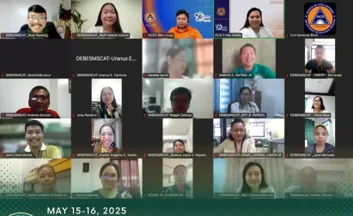
Personnel of the Dr. Emilio B. Espinosa Sr. Memorial State College of Agriculture and Technology (DEBESMSCAT) participated in a two-day online Disaster Risk Reduction and Management (DRRM) training conducted by the Office of Civil Defense (OCD) Region V on May 15–16, 2025, via Zoom.
The training aimed to equip public sector employees with the knowledge and skills necessary to integrate disaster risk reduction and management into government services. It emphasized the importance of identifying disaster-related risks, strengthening emergency preparedness, and ensuring the continuity of government operations during emergencies.
The training covered various topics, including the salient provisions of Republic Act No. 10121, or the Philippine Disaster Risk Reduction and Management Act of 2010. Participants also gained insights into different types of hazards, including hydrometeorological hazards such as thunderstorms, heavy rainfall, and tornadoes, as well as geohazards such as earthquakes and landslides.
Resource speakers from the Philippine Atmospheric, Geophysical and Astronomical Services Administration (PAGASA), the Philippine Red Cross, the Department of Science and Technology Region V (DOST-V), and the Bureau of Fire Protection Region V (BFP-V) discussed essential DRRM practices, including first-aid procedures, fire prevention, and the use of the DOST HazardHunterPH website to identify potential hazards in specific locations.
As a concrete initiative to strengthen its commitment to climate change adaptation and disaster resilience, DEBESMSCAT plans to develop a Cooperative Climate Disaster Preparedness and Response Plan in coordination with the local government units (LGUs), the Office of Civil Defense, and other relevant government agencies. The proposed plan will focus on establishing coordinated procedures for early warning dissemination, emergency evacuation, temporary shelter, and the provision of essential assistance to students, personnel, and nearby communities affected by climate-related disasters. It will also consider arrangements for assisting displaced individuals and families, including those who may need to relocate to other municipalities or provinces, while coordinating with appropriate government authorities when displacement extends across national borders.
Through this proposed initiative, DEBESMSCAT aims to strengthen inter-agency collaboration, improve emergency response coordination, and promote a proactive approach to managing climate-related risks. By working closely with government partners, the institution seeks to contribute to the protection of lives, the continuity of educational services, and the development of safer and more resilient communities.
 Ladies and gentlemen,

