





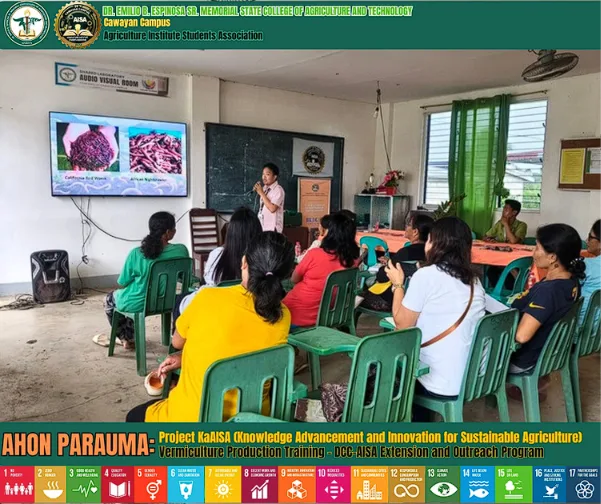
The DEBESMSCAT Cawayan Campus Agriculture Institute Students Association (DCC-AISA) conducted AHON PARAUMA: Project KaAISA (Knowledge Advancement and Innovation for Sustainable Agriculture) in Barangay Maihao, Cawayan, Masbate. This community extension project gave local farmers agricultural education, practical skills training, and resource assistance, all free of charge. It supports SDG 1: No Poverty by giving farming households in the local community the knowledge and resources to start and sustain agriculture-based livelihood activities and small enterprises.
In rural areas, limited access to technical knowledge and production resources makes it harder for farming households to start an income-generating activity. Project KaAISA addresses this through relevant education and resources. Training workshops and hands-on demonstrations introduced participating farmers to sustainable farming practices, the efficient use of locally available materials, and ways to reduce production costs and improve household income and local agricultural productivity.
To complement the training, DCC-AISA distributed vegetable seeds and garden tool sets as free start-up resources for backyard gardening, vegetable production, and other sustainable agricultural activities. With this knowledge and these resources, farmers are better equipped to explore livelihood opportunities, lower production costs, and build income-generating activities within their own communities, which strengthens their economic empowerment and resilience.
The project was carried out by the DCC-AISA officers, guided by their adviser and supported by the Bachelor of Science in Agriculture (BSA) Program Head, the Technical Advisory and Extension Services Office, and the Campus Administrator.
Through Project KaAISA, DEBESMSCAT–Cawayan Campus shows how extension services, training workshops, knowledge transfer, and access to basic production resources together provide local start-up assistance. The project encourages sustainable livelihood development, community-based entrepreneurship, and stronger partnerships between the university and local communities, and it reflects the institution’s commitment to poverty alleviation.
 Ladies and gentlemen,

