





Higher education institutions in vulnerable agrarian regions serve as vital social protection engines that promote regional economic growth and reduce income inequality. At Dr. Emilio B. Espinosa, Sr. Memorial State College of Agriculture and Technology (DEBESMSCAT) in Masbate, led by SUC President III Dr. Arnel B. Millesca, the institutionalized Student Assistantship Program serves as a direct pro-poor policy supporting United Nations Sustainable Development Goal 1 (SDG 1: No Poverty). The initiative alleviates household financial hardship, prevents academic dropouts caused by economic distress, and builds long-term human capital among low-income students.
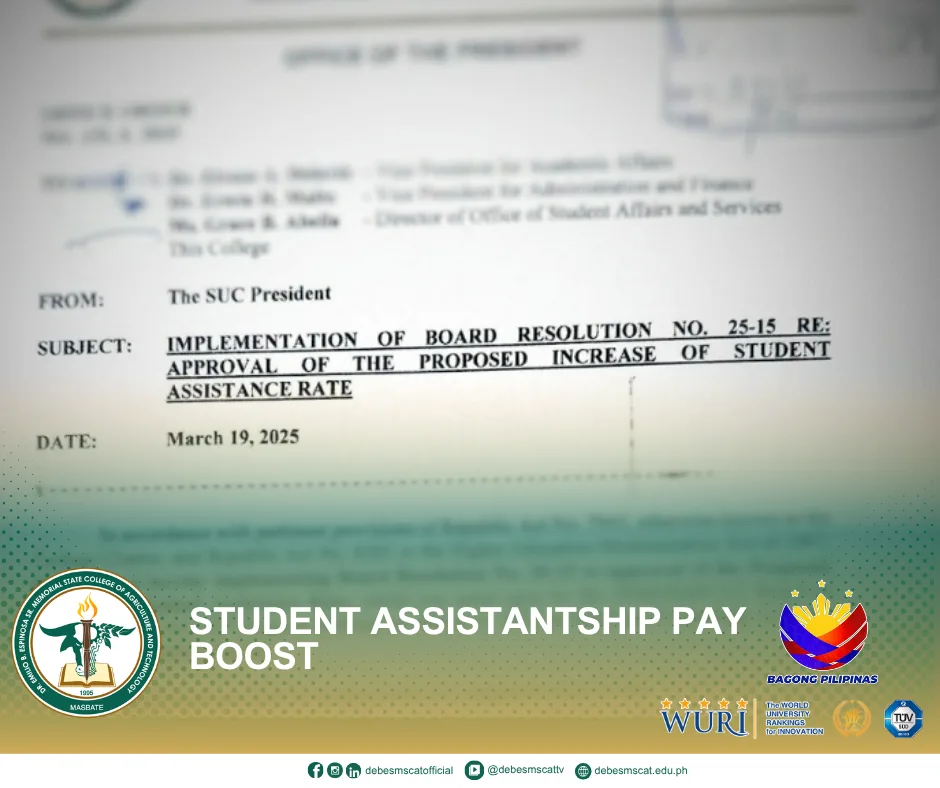
The central highlight of this policy reform is a major wage expansion under Office Order No. 133 (Series of 2025). To help students meet rising living standards and basic nutritional needs, DEBESMSCAT replaced its legacy hourly wage of Php 25.00 with a progressive, multi-year rate increase: Php 35.00 per hour in Academic Year 2025–2026, Php 45.00 in AY 2026–2027, and Php 50.00 in AY 2027–2028 and beyond. Supported by dedicated annual budgets expanding from Php 300,000.00 to Php 500,000.00 under the Free Higher Education scheme (Republic Act No. 10931), this 100% cumulative wage increase transforms student assistantships into a functional micro-earning platform that directly boosts household income for fragile rural families.
To ensure work duties support rather than hinder academic success, operational rules under Appendix H enforce protective workload limits. Work service is capped at a maximum of four hours per day during active semesters and scaled dynamically according to enrolled academic credits. Strict student welfare safeguards ensure work schedules never conflict with class hours, prohibit personal errands, and mandate that all duties directly foster professional skill acquisition and verified work experience.
By integrating rural youth into formal campus payroll systems, DEBESMSCAT aligns its policy with global poverty reduction strategies advocated by UNESCO, UNICEF, and the World Bank. The expanded wage structure and structured safeguards promote financial inclusion, lower local Gini inequality, and build economic resilience against asset poverty. Equipping low-income learners with economic self-sufficiency and certified career readiness facilitates smooth transitions into skilled labor markets, actively interrupting intergenerational cycles of poverty across the region.
 Ladies and gentlemen,

