





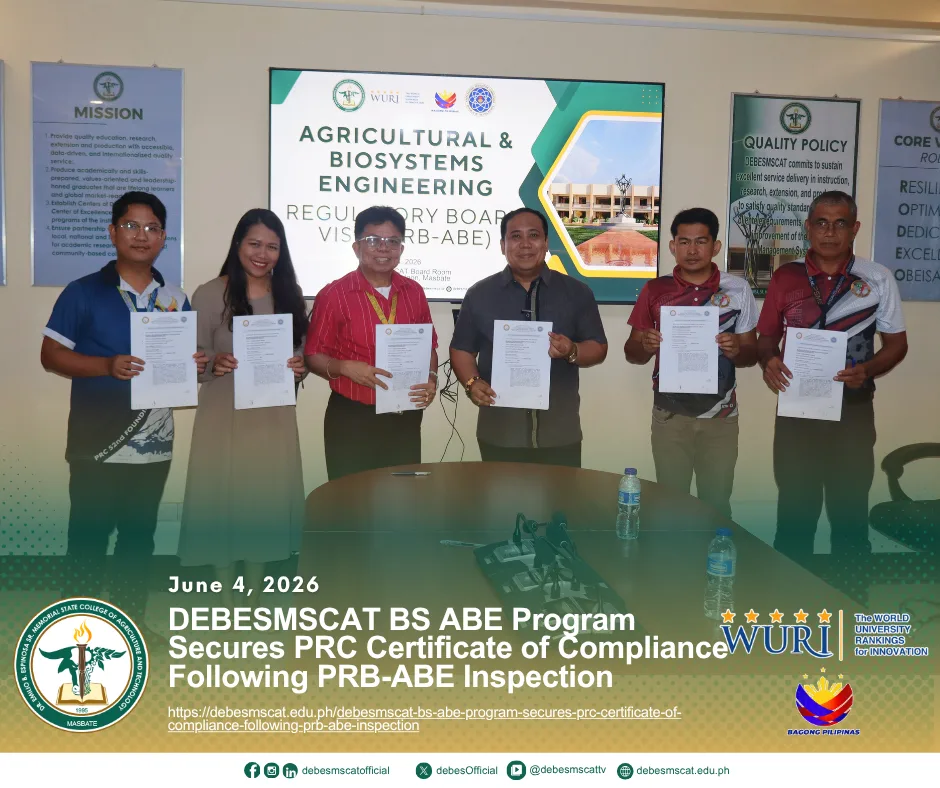
June 4, 2026 — The Bachelor of Science in Agricultural and Biosystems Engineering (BS ABE) program of Dr. Emilio B. Espinosa Sr. Memorial State College of Agriculture and Technology (DEBESMSCAT) achieved a significant milestone after successfully undergoing an inspection conducted by the Professional Regulatory Board of Agricultural and Biosystems Engineering (PRB-ABE) on June 4, 2026, at the College Board Room.
Following the comprehensive evaluation, the inspection team, led by PRB-ABE Chairperson Hon. Sherwin O. Valdez, recommended the program for the issuance of a Professional Regulation Commission (PRC) Certificate of Compliance, signifying that the BS ABE program satisfactorily met the prescribed standards and requirements for agricultural and biosystems engineering education.
The inspection covered key areas of compliance, including faculty qualifications, curriculum implementation, institutional policies, laboratory facilities, instructional resources, and engineering equipment. Chairperson Valdez emphasized that the activity was not merely an assessment but a collaborative effort aimed at strengthening and continuously improving engineering education programs.
Present during the inspection were Dr. Arnel B. Millesca, SUC President III, and Dr. Elreen A. Delavin, Vice President for Academic Affairs, whose leadership and support reflected the institution’s commitment to academic excellence and quality assurance. Also present were Engr. Arnold I. Malag, Dean of the College of Engineering, Engr. Michael A. Lucernas, BS ABE Department Head, and the BS ABE faculty members, who actively participated in the evaluation process.
The issuance of the PRC Certificate of Compliance serves as a testament to DEBESMSCAT’s dedication to maintaining high standards in engineering education and ensuring that its graduates possess the competencies expected of future agricultural and biosystems engineers.
This accomplishment further strengthens DEBESMSCAT’s position as a leading institution in engineering and agricultural education, committed to producing competent professionals who can contribute to agricultural modernization, sustainable development, and the advancement of the country’s food security initiatives.
 Ladies and gentlemen,

