





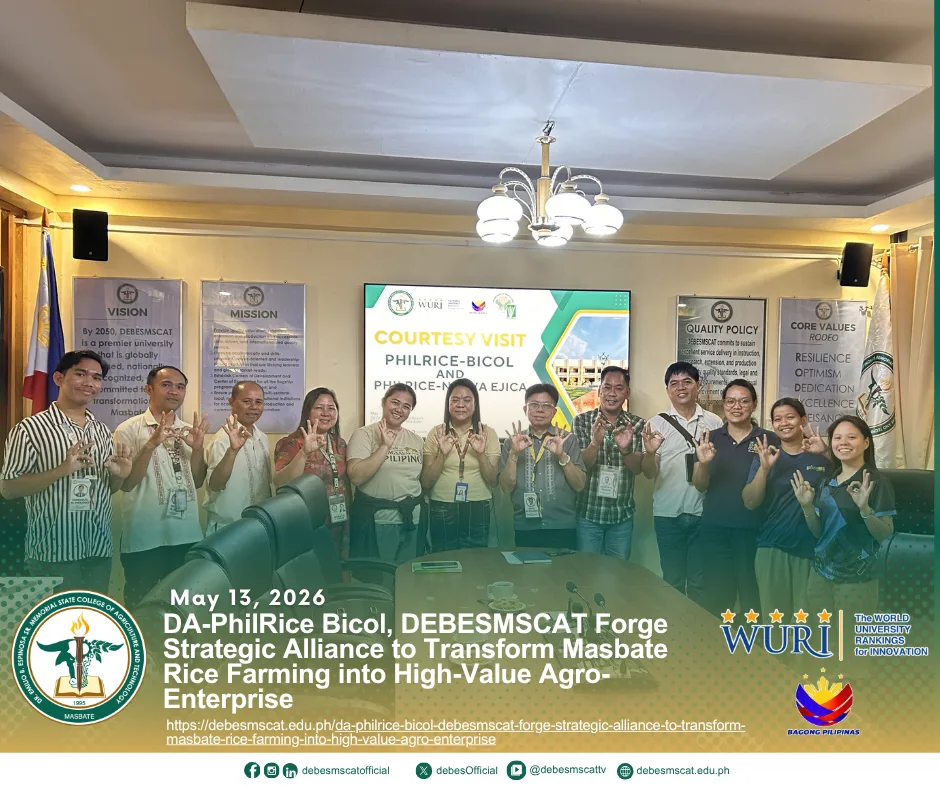
MANDAON, MASBATE — In a major move to break the cycle of low productivity and poverty in the local agricultural sector, the Philippine Rice Research Institute (DA-PhilRice) Bicol and the Dr. Emilio B. Espinosa Sr. Memorial State College of Agriculture and Technology (DEBESMSCAT) have entered into a strategic partnership to implement the Rice Business Innovations System (RiceBIS 2.0) Program.
The collaboration was formalized during a high-level courtesy call on May 13, 2026, where DA-PhilRice Bicol representatives met with DEBESMSCAT President Dr. Arnel B. Millesca, Dr. Erwin H. Malto, Vice President for Administration and Finance, Mr. Dennis G. Corlet, TAEX Director, Dr. Michael O. Ogaya, College of Agriculture (CA) Dean and other CA faculty members. The meeting centered on a shared vision: transitioning Masbate’s rice farmers from traditional “production units” into competitive “agro-enterpreneurs.”
Data presented by PhilRice experts highlighted a stark reality for smallholder farmers in the province. Currently, many farmers are trapped in a system of weak incentives and low investment.
One of the most significant hurdles identified is the price differential gap. Smallholder farmers rarely benefit from the higher retail prices of rice; instead, they are often limited to selling at low “farm gate” prices due to a lack of market connectivity and a misunderstanding of supply and demand dynamics.
The RiceBIS 2.0 program introduces a fundamental “Paradigm Shift” in local agriculture. Unlike traditional models that focus solely on how to grow crops, this new approach treats the farm as a business unit.
The proposed partnership between PhilRice and DEBESMSCAT has set an ambitious but concrete goal: attaining at least a 50% increase in income for assisted RiceBIS communities by the year 2028. To achieve this, the initiative will focus on three key pillars:
- Strengthening Capacity: Empowering Farmer Cooperatives and Associations (FCAs) in Milagros and Mandaon with organizational management skills.
- Bargaining Power: Equipping farmers to attain economies of scale, allowing them to negotiate better prices.
- Market Linkage: Establishing direct lines between rice-based products and higher-value markets, ensuring that “value-added” produce reaches the consumer.
The program is already operational across several key areas in Masbate. In Milagros, cooperatives such as the Baclay Agrarian Reform Beneficiaries Cooperative and the Matiporon Rice Farmer’s Agriculture Cooperative are leading the charge. In Mandaon, the Cabitan Masipag Farmer’s Agriculture Cooperative stands as a primary partner in this institutional development effort.
By involving DEBESMSCAT, the program ensures that scientific research and academic expertise are directly applied to the field. This “inclusive agro-enterprise model” is designed to be gender-sensitive and sustainable, providing policy recommendations and technical assistance that are tailored to the unique landscape of Masbate.
As this partnership moves forward, the message from both DA-PhilRice and DEBESMSCAT is clear: the future of Masbateño rice farming lies not just in the soil, but in the marketplace.
 Ladies and gentlemen,

